Depreciation and Capital Allowances
Do you know the difference and when each should be used?
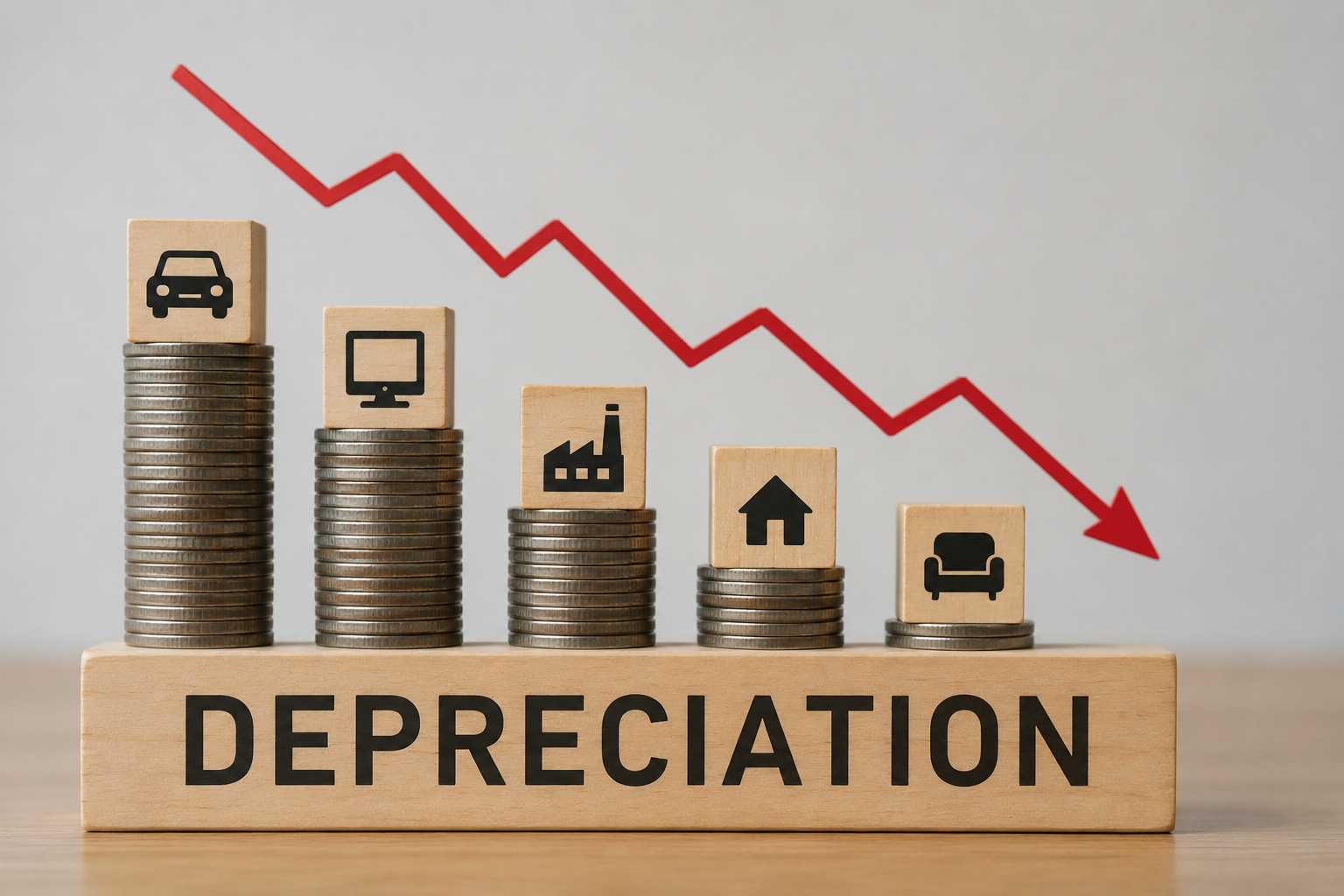
In very simple terms depreciation is the way of reflecting the reduction in value of an asset in the financial statements. However, as individual business entities are able to decide on how they depreciate their assets, depreciation is not allowable from a taxation purpose to calculate your taxable profits. Capital allowances are a way of then claiming some or all of the value of your assets, which can be deducted from your taxable profits.
Depreciation
The dictionary definition of depreciation is 'The reduction of the value of an asset over time, due in particular to wear and tear'.
What does this mean from an accounting perspective?
Essentially it is ensuring that the value of a non-current asset that you have in your business, whether that's a property, a machine, a vehicle, as examples, are recorded at a value that is reflective of their present value if you were to sell it in its current condition.
Without having your asset revalued on a regular basis to confirm its value at a specific point in time, the method by which this value can then be determined is by using depreciation.
As a brief overview this is achieved by initially ensuring the correct value of the asset is recorded at the date of purchase, deciding on the useful life of the asset i.e. how long the asset will last before needing to be replaced, and then whether there would be any residual value in the asset at the end of this lifetime. The difference in value between its initial cost value and its residual value would then be spread over the length of its useful lifetime as expense postings to your profit and loss. This should then in theory mean that the asset's 'carrying amount' (the value of the asset less all depreciation charges to the current point in time) is a fairly close representation of its actual value.
Initial Valuation
International Accounting Standard 16 Property, Plant and Equipment sets out the guidance for how an asset should be initially valued. Its states that an assets initial valuation should be a combination of; its purchase price, any directly attributable costs to get the asset to the current location and be in a condition for its intended use i.e. delivery costs, installation costs, professional fees, as well as an initial estimate of the cost of subsequently dismantling and removing the asset and restoring the site back to its previous condition (when there is an obligation to incur such costs).
So as an example you purchase a property at £250,000 which incurs estate agent fees of £5,000.
The property would be recorded in the financial statements at an initial valuation of £255,000.
Subsequent Expenditure
There are then some additional costs that can also be capitalised according to IAS 16, these include; expenditure that will improve the future economic benefits that the asset will generate (like an extension on a rental property which allows you to charge an increased rent), or it replaces a component of an asset that greatly prolongs the life of the usable asset.
Following up on the previous example if the property that was purchased had an extension costing £35,000 built, as well as a full interior redecoration costing £4,500.
In this instance the extension is classed as capital expenditure and so the £35,000 can be incorporated in to the value of the asset in the financial statements, whereas, the redecoration costs are deemed to be revenue expenditure and would have to be written off as an expense in the years profit and loss.
This brings the initial value of our property to £290,000 which would be recognised as a Non-current Asset in the Statement of Financial Position.
Useful Life and Residual Value
On the acquisition of an asset an estimation should be made of both its useful life and its residual value.
Its useful life would be the expected period of time that the asset would be used before being disposed of and potentially replaced with a replacement. There are general lifespans that can be assigned to certain classes of asset, for example HMRC currently deems the useful life of a phone to be between 2-3 years, due to the rapidly changing advancements in technology. So a little bit of research should provide a general idea of what the expected useful lifespan of your asset should be.
The residual value is the amount that the business would be expected to receive from disposal of the asset at the end of this useful life. In some cases this may be zero, however there are also a lot of cases where you could still expect to make some money from the sale of the asset, whether that be scrap value or just second hand values, again this may just need a little research to see what an expected residual value would be.
Depreciation Method
The final piece of the jigsaw is then which of the two main methods of depreciation to choose from to apply to your asset.
There is the straight line depreciation method, this is where the same value of depreciation is posted every period for the duration of the assets useful life until the carrying amount becomes the same as the residual value initially decided upon.
So using a laptop as an example, if it was purchased initially for £1,000, with a useful life of 3 years and a residual value of £250, £750 would need to be depreciated over the 3 year life in equal portions.
This would equate to £250 per year, or £20.83 every month.
This would be posted as a debit to Depreciation, which would be reflected as an expense in your statement of profit and loss, and a credit to accumulated depreciation which would be reflected in your statement of financial position.
The second most commonly used method would be the diminishing balance method. This is where a fixed percentage of the assets carrying amount is charged in each period as an expense to the profit and loss. This method is particularly useful for reflecting how the value changes in certain types of assets like Vehicles or Machinery, where there may be a steep decline in the assets value immediately after purchase, which then levels out over time.
Taking a car purchased at £15,000 as an example, if you were to depreciate this using the diminishing balance method over its useful life of 10 years, to a residual value of £1,000 and a percentage of 50% per year.
The depreciation expense would be calculated as:
Depreciation Expense = (Carrying Value - Residual Value) x Depreciation rate
For Year 1 of purchase this equates to = (£15,000 - £1,000) x 50% = £7,000
So for Year 1 the total depreciation expense to be charged to the profit and loss would be £7,000, this can then be split equally over the 12 months to be a monthly charge of £583.33.
For Year 2 the carrying amount of the car would have been reduced to £8,000, so the formula for year 2 becomes = (£8,000 - £1,000) x 50% = £3,500
This shows how the depreciation charge decreases year on year to reflect the behaviour of the actual valuation of the car.
This calculation would then be completed every year until the end of its useful life.
Depreciation Summary
The above is a basic run-through and explanation of how depreciation should be used to help accurately reflect the value of your assets in your accounts to take account of general use and wear and tear.
Just a couple of points to be aware of though,
IAS 16 states that all items of the same class should be depreciated using the same method, this means that if you decide to use the diminishing balance method for example to depreciate the value of a car, any further vehicles that you own should be depreciated using the diminishing balance method too.
If at any point in time the asset has a formal valuation and either the valuation differs greatly from the carrying value at that point, or the useful life remaining is deemed to have changed, adjustments would need to be made to reflect these new values, which would impact the ongoing depreciation expenses. Although I will not discuss these changes in any further detail in this blog post, this is more to make you aware and to see advice as to the next steps.
Finally, to emphasise that Depreciation is not an allowable expense from a taxation perspective, therefore when completing your tax return, depreciation expenses for the year must be added back on to your year ending net profit and loss figure. However this brings us on to the alternative that is allowable from a taxation perspective, Capital Allowances.
Capital Allowances
Capital Allowances are a method of tax relief for businesses, they allow you to deduct some or all of the value of a purchased asset from your profits before your tax is calculated. Capital Allowances can be claimed against qualifying purchases including: Equipment, Machinery and business vehicles, these are all deemed as 'Plant and Machinery'.
When claiming for Capital Allowances, you are only allowed to claim for the proportion of an items cost that is deemed to be for business use, for example a laptop that cost £1,000, that is used 50% for business use and 50% for personal use, only the £500 business portion would be claimable as a capital allowance.
There are a range of Capital Allowances that can be claimed for, the most common ones are as follows.
Annual Investment Allowance (AIA)
The Annual Investment Allowance currently allows you to claim for up to £1 million of qualifying plant and machinery purchases in your 12 month financial year, (this would need to be apportioned to a relevant value if your accounting period is less than 12 months, for example a 9 month period would equate to an AIA of only £750,000). The cost price that can be claimed for would normally be the price that the items have been purchased for. Items that AIA cannot be claimed for include: Business cars, items owned for a previous reason other than the business or items that have been gifted to you or the business.
100% First Year Allowance
If purchased before April 2027 you can claim 100% first year allowances on: electric cars and cars with zero CO2 emissions, equipment for electric vehicle charging points. This allowance can be claimed in addition to another first year allowance or AIA, as long as the same costs are not being claimed for.
Full Expensing and 50% First Year allowance
Only companies can use this capital allowance to claim against their costs. They can both be claimed against the cost of certain plant and machinery, but they must have been bought from 1st April 2023, be new and unused and not be a car. As suggested by the names, full expensing allows you to claim 100% of the cost of qualifying plant and machinery, while 50% first year allowance allows you to claim 50% of the cost of qualifying plant and machinery. Which of the two of these allowances you can claim for depends specifically on the type of Plant and Machinery that has been purchased.
40% First Year Allowance
Very similar to Full expensing and 50% first year allowance, but only 40% of the full cost value can be claimed in the year of purchase. The conditions for this to be claimed are: It must have been bought on or after 1st January 2026, be new and unused, it needs to qualify for the main rate of writing down allowance (will explain this shortly) and not be a car.
Write Down Allowances
Writing Down Allowances are a capital allowance that allow you to claim a proportion of an assets cost on an annual reducing balance basis. If a type of first year allowance has been claimed for this will then allow you to slowly claim the remaining balance that has not been claimed for in the year of purchase.
As a simple example, for an asset that was purchased at a cost value of £10,000, and did not qualify for any of the other allowances described above, this would be assigned to a 'pool' of assets.
Which pool it is assigned to would depend on the asset that has been purchased, a car for example would depend on the emissions rating of the individual car, this would then impact the percentage that can be used for the write down allowance.
If this asset was deemed to fall in to the main pool and was purchased from April 2026, it would qualify for an annual write down allowance of 14%. This would mean that 14% of the cost could be claimed and used to offset profits in year 1.
£10,000 x 14% = £1,400 to be claimed.
In year 2 the balance of the pool would then have been reduced to £8,600, so the year 2 allowance would be:
£8,600 x 14% = £1,204 to be claimed, leaving a pool balance of £7,396 and so on for each subsequent year.
There are three types of asset pools: The 14% main pool from April 2026 (was 18% prior to April 2026), the 6% special rate pool and a single asset pool where the rate depends on the specific item.
Things to Remember for Capital Allowances
Most importantly you can only claim capital allowances for assets that are used for the business, if an asset is used for both business and personal use, you may only claim for a proportion of the total cost value which matches the proportion of business use.
If you claim capital allowances for an asset and this is subsequently sold, there may be a necessity to for a subsequent balancing allowance or balancing charge to be applied to your profits, dependant on the value of allowance claimed up to the point of sale and the revenue generated from the sale.
Finally be sure to check which allowance your asset qualifies for, this will depend entirely on what the asset is, whether it is new and has never been used previously, what its emission ratings are and more. The allowances available are also subject to change over time.
Hopefully you should now have a better understanding as to what the differences are between Depreciation and Capital Allowances, and know when it is relevant for each of these to be applied to your finances.